


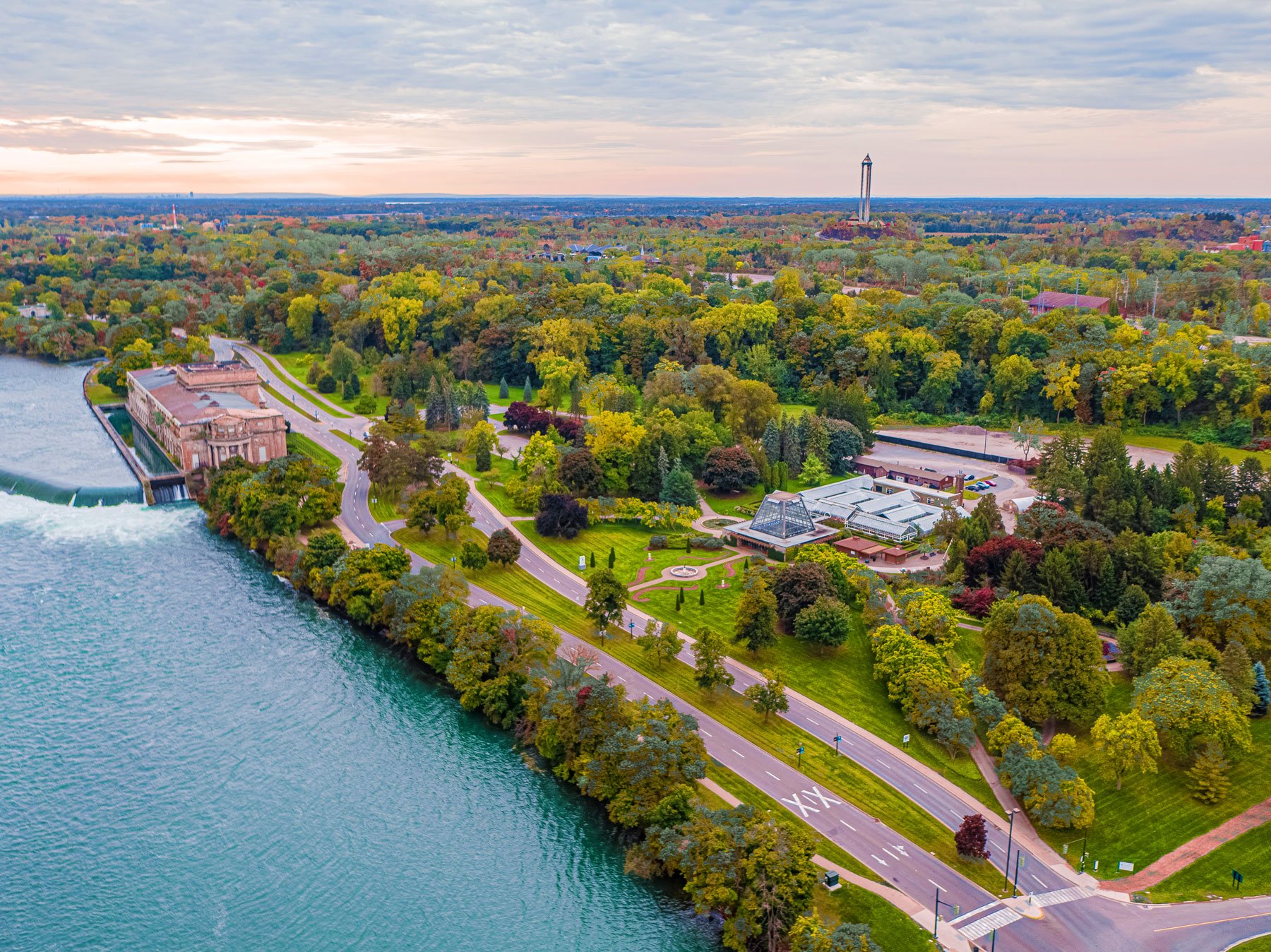

Niagara Falls is among the most photographed natural landmarks in the world, yet its visual identity shifts meaningfully outside peak summer. In the weeks leading into high season—typically from mid-April through late May—the landscape reveals a quieter, more nuanced character. Gardens begin to bloom, river levels run strong with spring melt, and vantage points that later fill with visitors remain comparatively open.
- Oakes Garden Theatre’s Framed Falls
- The Whirlpool Aero Car in Motion
- Niagara Parks Power Station’s Underground Tunnel to River
- The Illumination Towers at Dusk
- Queen Street Murals, Downtown Niagara Falls
- Hidden Pull-Offs Along the Niagara Parkway
- The Floral Showhouse’s Hidden Corners
- Whirlpool Rapids by Jet Boat
- Niagara-on-the-Lake’s Secret Courtyards
- Capturing Niagara Differently
- Practical Notes for Your Visit: FAQ
For travelers seeking original photography, this shoulder season offers both clarity and access. Angles that are difficult to compose in July become practical in May. Light behaves differently, with softer mornings, longer golden hours, and cooler air that sharpens detail across the gorge. The result is a version of Niagara that feels less staged and more dimensional—one where architectural, industrial, and natural elements share equal presence.
Oakes Garden Theatre’s Framed Falls
Positioned at the base of Clifton Hill, Oakes Garden Theatre offers one of the most structured compositions in the city. Its terraced layout, curved staircases, and formal garden beds naturally guide the eye toward the distant crest of Horseshoe Falls.
Early-season visitors often find the geometry easier to work with. Spring plantings introduce fresh color without the density of midsummer blooms, allowing architectural lines to remain prominent. Photographers tend to favor the upper terraces, where the garden’s symmetry can be used to frame the Falls in a balanced, vertical composition. Morning light, filtered through lingering mist, adds subtle contrast without harsh shadows.
The Whirlpool Aero Car in Motion
Further north along the Niagara Parkway, the Whirlpool Aero Car introduces motion into the landscape. Suspended above the swirling basin of the Niagara Whirlpool, the cable car provides a striking focal point against the deep green currents below.
In shoulder season, the surrounding foliage has not yet fully leafed out, which can open clearer sightlines into the gorge. Late afternoon is particularly effective here. As sunlight lowers, it reaches deeper into the canyon, illuminating the water’s movement and creating contrast between the bright car and the darker rock walls.
Niagara Parks Power Station’s Underground Tunnel to River
Niagara’s photographic appeal extends beyond its natural features into its industrial history. The restored Niagara Parks Power Station, a monumental early 20th-century hydroelectric facility, offers one of the most distinctive indoor-outdoor compositions in the region.
The 2,200-foot tailrace tunnel is the defining feature. Descending below the main generator hall, the tunnel leads to a river-level platform where the scale of the gorge becomes immediate. The most effective compositions are often made from within the tunnel itself, using the bright opening as a natural frame. Spring’s moderate visitor flow makes it easier to work with longer exposures and stable setups, particularly for those balancing interior shadow with exterior light.
The Illumination Towers at Dusk
Nightfall at Niagara is widely associated with the illuminated Falls, yet fewer visitors consider the towers responsible for that display. Located on the Canadian side, these steel structures provide an alternative subject—one that emphasizes infrastructure rather than spectacle.
Blue hour, the period just after sunset, offers the most balanced conditions. The sky retains color, the towers become defined silhouettes, and the first beams begin to cut through the mist. With fewer crowds before peak season, tripods and longer exposures are easier to manage in this area, allowing for more deliberate compositions.
Queen Street Murals, Downtown Niagara Falls
A short distance from the Falls, Queen Street presents a different visual narrative. Here, large-scale murals transform brick facades into contemporary canvases. The tone shifts from natural spectacle to urban creativity, offering bold color palettes and graphic compositions.
Photographers often work with off-center framing in this setting, allowing the artwork to dominate while incorporating a human subject for scale. Early-season timing again plays a role; with lighter foot traffic, it becomes easier to capture clean, uninterrupted scenes.
Hidden Pull-Offs Along the Niagara Parkway
The Niagara Parkway, frequently described as one of the most scenic drives in the region, reveals its most photogenic details between its main stops. Small pull-offs, often overlooked, provide access to intimate river views framed by willows, stonework, and gently curving roads.
In spring, these areas carry a subdued palette—muted greens, early blossoms, and reflective water surfaces. Late-day light enhances texture along the banks, turning otherwise simple compositions into layered landscapes.
The Floral Showhouse’s Hidden Corners
Near the Falls, the Floral Showhouse offers a controlled contrast to the outdoor environment. Inside, rotating displays provide saturated color and consistent lighting, while exterior features such as ponds and gazebos introduce reflective compositions.
Weekday mornings tend to offer the most workable conditions. Blooms are at their freshest, and the pace remains unhurried, allowing time to refine framing and focus on detail.
Whirlpool Rapids by Jet Boat
The Niagara Whirlpool is among the most dynamic natural features in the region. While it can be observed from above, its scale becomes more apparent at water level. Jet boat excursions introduce both motion and unpredictability into photography, with shifting angles and fast-changing light.
Afternoon departures are often preferred, as sunlight penetrates deeper into the gorge, intensifying the color of the water. Capturing both the environment and human reaction—spray, movement, and expression—creates a more complete visual record of the experience.
Niagara-on-the-Lake’s Secret Courtyards
North of the Falls, Niagara-on-the-Lake provides a quieter, historically layered setting. Beyond its main street, narrow laneways and hidden courtyards introduce textures more commonly associated with older European towns—ivy-covered walls, iron gates, and brick pathways.
Early morning remains the most effective time to explore these spaces. Before shops open, the town retains a stillness that supports unobstructed compositions and softer, directional light.
Capturing Niagara Differently
Niagara Falls rewards familiarity, yet it also benefits from a shift in perspective. Looking beyond the main viewpoints reveals a region defined not only by its iconic cascade, but by its supporting landscapes—gardens, infrastructure, riverbanks, and towns that together shape the experience.
Before peak season, these elements align in a way that supports both exploration and thoughtful composition. The pace is manageable, the light is forgiving, and the setting feels more accessible to those willing to look past the obvious.
Practical Notes for Your Visit: FAQ
Mid-April through late May typically provides the most balanced conditions. Water flow is strong from spring melt, gardens begin to bloom, and visitor volume remains moderate. Early April can feel transitional, while late May starts to trend toward early summer crowds.
Early morning offers the softest light and the fewest people at major viewpoints. Late afternoon into golden hour brings warmer tones, especially along the Niagara Parkway and within the gorge. Blue hour—just after sunset—is ideal for capturing illuminated scenes and the Illumination Towers.
Locations slightly removed from the main viewing areas tend to be less crowded. Oakes Garden Theatre offers structured garden views, while stretches along the Niagara Parkway reveal quieter riverbanks and scenic pull-offs. Queen Street Niagara Falls provides a more urban setting with mural backdrops.
Yes. Niagara Parks Power Station features dramatic industrial architecture and a tunnel leading to the river, offering strong contrast between light and shadow. The Niagara Parks Floral Showhouse provides controlled lighting and vibrant seasonal displays.
Layered clothing is recommended, as temperatures can vary throughout the day. A waterproof jacket helps manage both spring rain and the mist near the Falls. Comfortable, water-resistant footwear is useful for extended walking.
Yes. Niagara-on-the-Lake offers a quieter, more historic setting with courtyards, laneways, and heritage architecture. Early morning visits provide the best light and minimal foot traffic.
Arriving early remains the most effective approach. Planning stops slightly outside the main tourist core—such as along the Parkway or in downtown Niagara Falls—also improves access to quieter compositions.
Tripods are generally permitted in most public outdoor spaces, particularly during less crowded periods. They are especially useful for low-light conditions at dusk or inside locations like the Power Station tunnel, though visitors should remain mindful of pedestrian flow and posted guidelines.
A full day allows for a range of lighting conditions and locations, from morning garden views to evening illumination. Many travelers find that spreading photography across two days provides greater flexibility, particularly when factoring in weather and changing light.