








Niagara Falls Ice Bridge
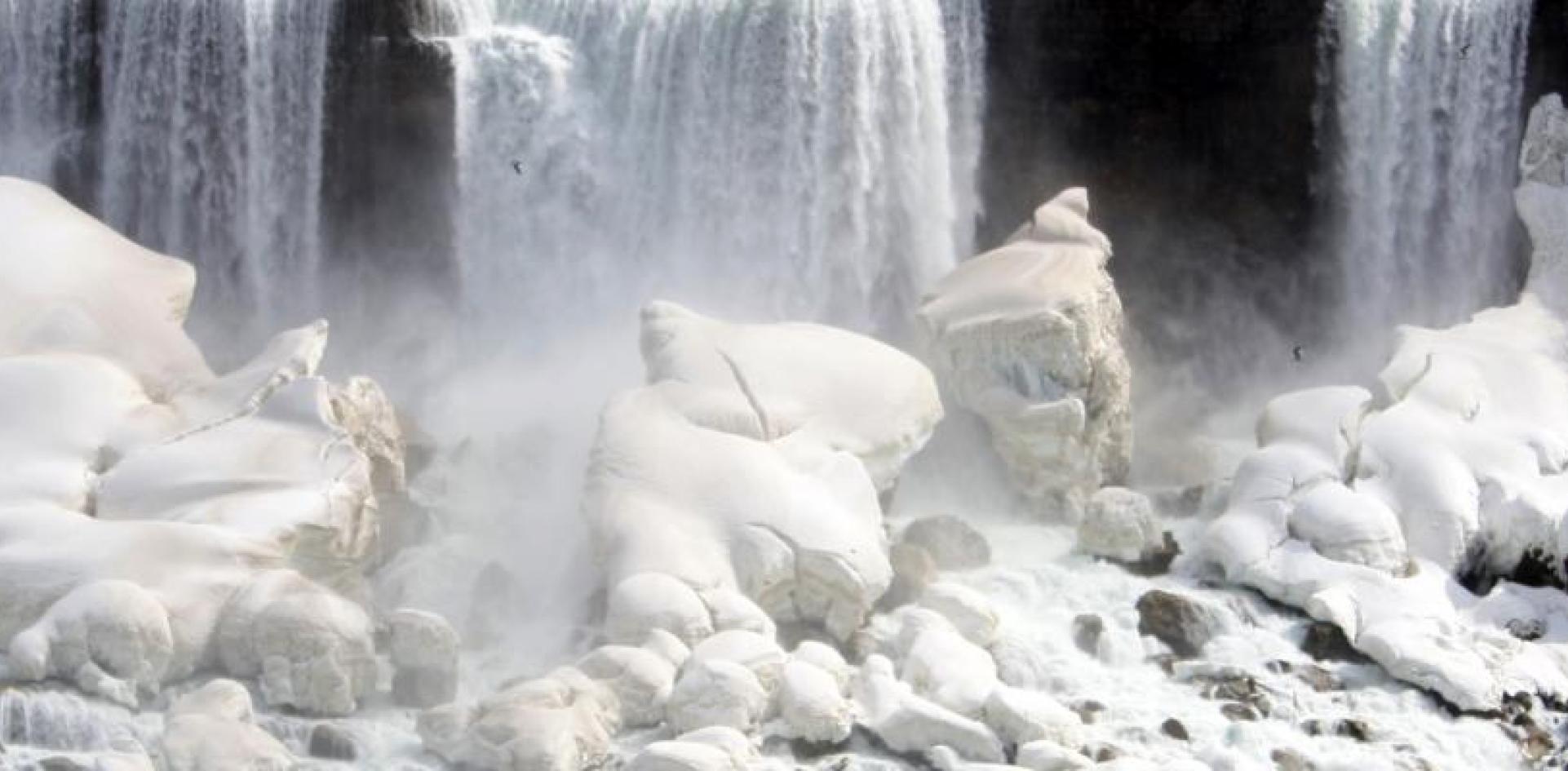
The ice bridge is one of Niagara's most spectacular winter wonders. It is created through a combination of circumstances. A mixture of ice and slush flows downriver from Lake Erie and drops over the Falls. When it reaches the Maid of the Mist eddy, just beyond the American Falls, it is forced into the Canadian bank where it jams. As more and more ice and slush push against it, the whole mass begins to heave and hump from the continuing pressure.
By Sherman Zavitz
When the ice particles are pushed up out of the water, they freeze in an agglomerate mass, which soon grows to a considerable size. This "suspended glacier" eventually reaches the American side of the gorge and a true ice bridge is created.
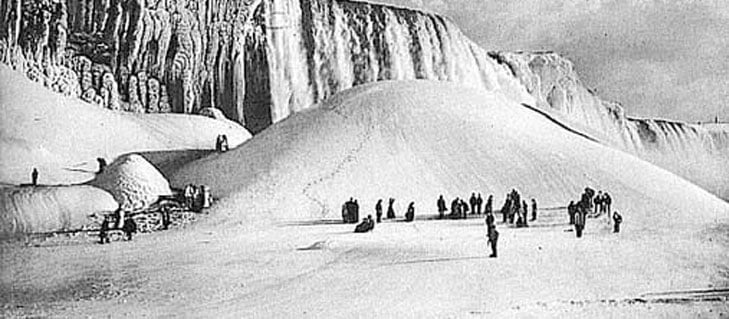
Generally extending for a mile or more downriver from the base of the Horseshoe Falls, the thickness and duration of the ice bridge depends on the severity of the weather. Some years it may form as early as December and last into April. Other years will see an ice bridge of a much shorter life span or, if it is really a mild winter, there will be no ice bridge at all.
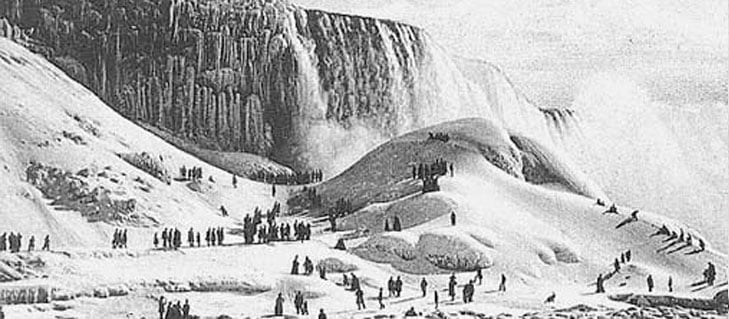
It also varies in appearance, sometimes having almost a flat surface while at other times it will be scoured with furrows and crevasses and dotted with huge hummocks.
Early Niagara guidebooks usually mentioned the ice bridge. This descriptive passage appeared in Orr's Pictorial Guide to Niagara Falls published in 1842:
"The river never freezes over but large masses of ice are sometimes collected and blocked in, so as to form a natural bridge, extending up to the foot of the Falls and for two miles down the stream. Magnificent views of the cataract are then obtained from the frozen platform and splendors surpassing the Polar Seas are beheld."
A bridge of this kind was formed below the Falls during the past winter of uncommon dimensions. The ice was not less than a hundred feet thick and rose above the water from thirty to forty feet. People crossed on it for some days."
An 1896 guidebook also described the ice bridge and mentioned how many people walked across it. However, a note of caution was also added: "The river is carefully watched for signs of break-up, for once the ice goes it goes with a rush. Woe be to any unhappy mortal carried down with it."
A century ago some people reached the ice bridge in an exciting and rather daring way. Beginning at the top of Clifton Hill, they would skate down the hill, cross River Road, and continue onto the road that leads to the Maid of the Mist dock Careening around the hairpin turns, the skaters would descend into the gorge and not stop until checked by the rough conditions out on the ice bridge. Most who took this challenge made the "trip" in one long glide.
This kind of experience was possible because of the road conditions of that era. Back when winter traffic was all on runners, the roads became quite hard and polished, especially those that received some spray from the Falls on freezing nights.
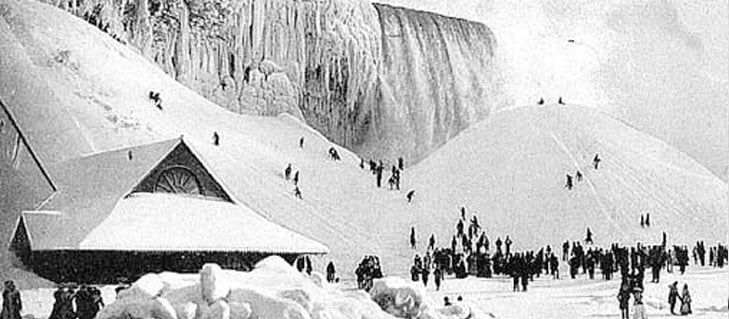
By the 1880s, the ice bridge had become not just something to gaze at or walk on. It was also a playground for the local population as well as tourists. Widely advertised, a good ice bridge was a bonanza to hotel operators, souvenir storeowners and guides who otherwise would not have much business during the winter.
An idea of just what took place on the ice bridge can be learned from an account that appeared in a Niagara Falls, Ontario newspaper on February 24, 1888:
"Last Sunday was a gala day on the ice bridge. The visitors during the day must have numbered fully twenty thousand, a large number of which were young people. They amused themselves all day either watching the tobogganers coast down the ice mound at Prospect Point corner or in trying the fun themselves. What laughing and yelling as some of the unlucky sports came to grief. The seven shanties on the ice were doing a good business in liquor, photographs or curiosities all day long."
These shanties were made of wood covered with tar paper. They almost always came from the Canadian side since the road leading from the foot of Clifton Hill down the side of the gorge to the ferry dock could be used. The shanties were then dragged out onto the ice and positioned along a rough pathway that was created from shore to shore. It was usually a very crooked path since crevasses and large mounds of ice had to be avoided.
Some of the businessmen in these shanties sold food or souvenirs, others offered to make tintype pictures and still others sold liquor. All seemed unconcerned with the 150 feet of water in their building's basement!
Laura Bradshaw Durand, a columnist for the Toronto Globe (now the Globe and Mail), experienced the ice bridge during February 1896. She later wrote: "In the middle of the ice bridge, as if mocking the elements, stood a rather frail wooden booth with signs indicating that beef-tea, cake and coffee were for sale there."
Those shanties selling liquor (illegally, of course) were always located closest to the center of the river. There was a good reason for this. If the owner of the "saloon" was charged with a liquor violation, he had a good chance of having the charge dropped since the boundary line was always disputed at the trial. If Canadian officials had laid the charge, the defendant would claim that his shanty was actually in the United States or vice versa. Shifting ice conditions often helped to bolster the defendant's argument.
The fun continued until February 4, 1912. On that day the ice bridge suddenly broke up and went downriver carrying three people to their deaths. From that time on, it was illegal to go out on the ice bridge.
* Photos provided by Edsen Breyer's Postcard Museum