







Niagara Falls Tourism History
By Sherman Zavitz
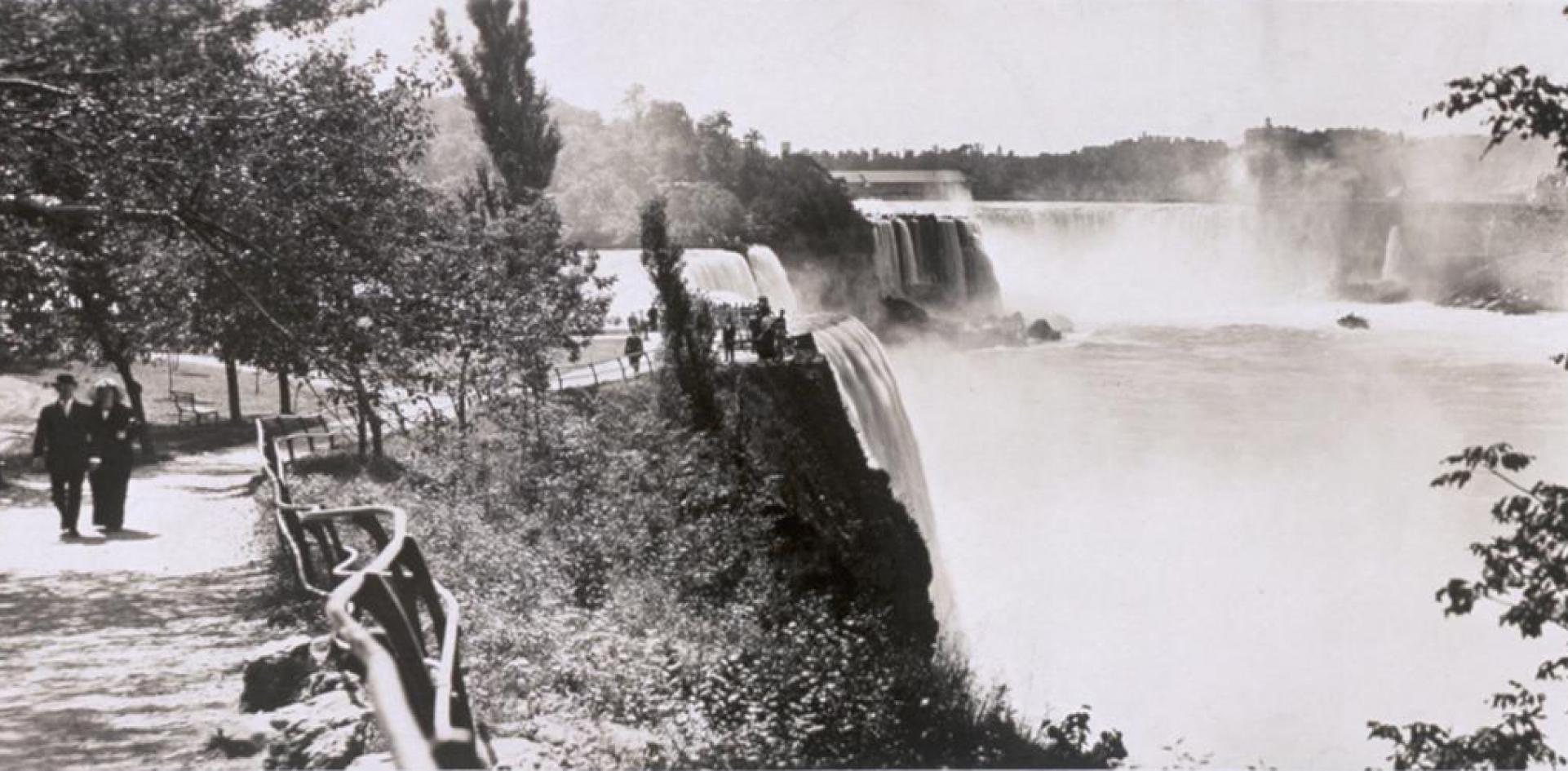
For most people living in the 19th century, a visit to Niagara Falls was the trip of a lifetime. As a result, they attempted to make it as memorable and enjoyable an experience as possible.
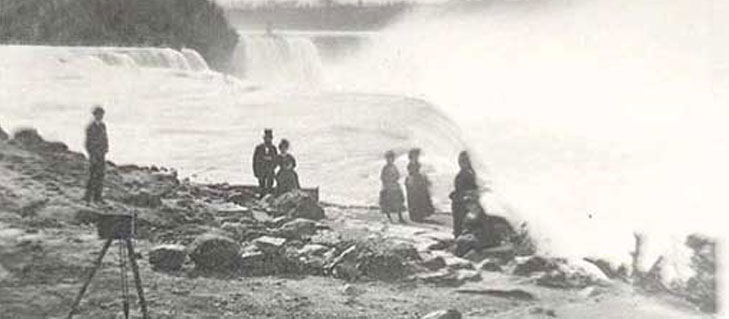
British author Fanny Trollope had this in mind when she and her two daughters came to Niagara Falls during June of 1831 for a four-day visit. She later wrote: "We drenched ourselves in spray; we cut our feet on the rocks; we blistered our faces in the sun; we looked up the cataract and down the cataract; we perched ourselves on every pinnacle we could find; we dipped our fingers in the flood at a few yards distance from its thundering fall; in short, we strove to fill as many niches of memory with Niagara as possible." With such an energetic and thorough look, there's no doubt the visit was an experience they would always remember with great pleasure.
Although Fanny doesn't mention it, she and her girls may have also visited the Burning Spring. This was Niagara Falls' first and for many years one of its most famous extra attractions.
In the 1790s, while excavating for a mill in the area now known as Dufferin Islands, a natural gas "spring" was discovered. It was later learned that the gas, which bubbled up through the water, was coming from a layer of Queenston Shale running deep underground along the upper Niagara River. The excavators had accidentally enlarged the opening of an existing vent, allowing a rapid emission of natural gas. The phenomenon quickly became a local curiosity.
During the early 1820s, as a tourism industry began to develop at Niagara Falls, someone realized that this spring could became an attraction for visitors.
Accordingly, a building was constructed over it. The spring was then enclosed by a barrel with a long pipe protruding from the top. A cork stopper was place in the pipe, which caused the gas to build up pressure in the barrel.
After paying a fee, a visitor was escorted into the small darkened building. The attendant would then remove the cork and light the gas. Presto! You had a "Burning Spring."
Occasionally, visitors to Niagara Falls would also be entertained by a stunter. The first of these was Sam Patch. Sam, originally from Rhode Island, was a jumper.
He arrived in Niagara Falls in early October 1829. Before long, he had constructed a platform out in front of Goat Island, which separates the American and Canadian Falls. It was 85 feet above the river. On October 7, 1829, Sam jumped from this platform into the river. He survived.
Not content with either the size of his audience or his take, Sam announced that in a few days he would make an even higher jump. He then proceeded to raise his platform and on October 17 jumped from a height of 130 feet. Again, he miraculously survived.
Probably the most extraordinary stunters at Niagara Falls during the 19th century were the tightrope walkers. Over a number of years, they entertained and thrilled tens of thousands of people.
The first and most famous of these was Jean Francois Gravelet, who used the professional name Blondin. During the summers of 1859 and 1860, he gave a series of amazing performances on the tightrope, which was stretched across the Niagara Gorge some distance below the falls.
Examples of his artistry included the following: He would lie down on the rope; walk forward and then backward. He crossed the rope in a bag with only two holes cut in it for his hands and with his arms and legs shackled in irons.
On one occasion he pushed out a wheelbarrow containing a small stove. Stopping in the middle of the rope, he then cooked an omelet, half of which he ate before lowering the rest to passengers on the Maid of the Mist directly below.
Blondin put on shows during which he stood on his head, turned somersaults, hung from the rope by one arm and then one leg and for a finale crossed on stilts. He even carried a man across on his back, a man who had never been out on a tightrope before!
* Photos provided by Edsen Breyer's Postcard Museum, Mr. John Guthrie