







Clifton Hill History
By Sherman Zavitz
Clifton Hill owes its name to Captain Ogden Creighton. He was a half-pay officer in the British army who had served with the 70th and 81st Regiments in various parts of the world, including the Far East.
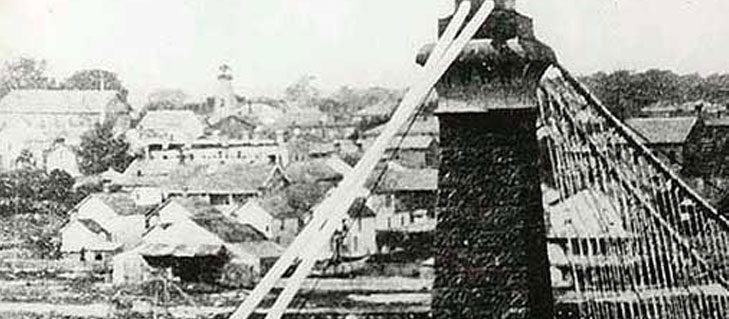
Around 1830, Captain Creighton came to Niagara Falls and acquired a sizeable tract of land on what is now the south side of Clifton Hill as well as the area just beyond the top of the hill.
He had this land surveyed and laid out for a town site, which he named Clifton, presumably after Clifton on the gorge of the River Avon in Bristol, England.
On the edge of the high bank facing the American Falls, Captain Creighton built his own residence, naming it Clifton Cottage. It stood where the Great Canadian Midway is now located.
At that time, present-day Clifton Hill was part of the Ferry Road that led to the ferry landing alongside the Niagara River where the Maid of the Mist dock is now situated. In this pre-bridge era, the ferry service was the only means of crossing the river.
Since there was relatively heavy traffic to and from the ferry, the captain realized that another business opportunity existed. This is referred to in a guidebook with the rather lengthy title of A Manual for the Use of Visitors to the Falls of Niagara, published in Buffalo in 1834. The author notes, "Capt. Creighton has laid out the village of Clifton. He has a beautiful site. I cannot refrain from noticing in terms of high commendation the beautiful, appropriate, chaste and Gothic building which he has lately erected at the head of the carriage road to the ferry and which is now leased by Mr. Fido as a confectionary." While Captain Creighton was heavily involved in real estate at Niagara Falls, he also served as a director of the Welland Canal Company, the private concern that had built the first Welland Canal between 1824 and 1829. During the mid 1830s, he acted as the company's treasurer.
The captain also played a role in the Rebellion of 1837. This uprising resulted from widespread discontent over the system of government in what was then the colony of Upper Canada, now the province of Ontario. While some just wanted reform leading to more responsible government, others wanted a complete break from England.
On December 5, 1837, some 800 rebels under the command of William Lyon Mackenzie clashed with a force of government militia just north of Toronto. The rebels were easily routed and Mackenzie was forced to flee for the United States with a price on his head.
A few days later, after narrowly escaping capture several times, he crossed the Niagara River and reached Buffalo. Shortly after this, Mackenzie and a few American sympathizers established a provisional government on Navy Island. This small Canadian island sits in the Niagara River, not far above the Horseshoe Falls. Tensions were high on both sides of the border until Mackenzie and his followers, who eventually numbered around 200, evacuated Navy Island in mid-January 1838. As a reserve officer and magistrate, Captain Creighton was involved in suppressing the uprising. Clifton Cottage became the headquarters for the militia detachment assigned to guard the ferry. Following Mackenzie's takeover of nearby Navy Island, local military activities were greatly increased and Captain Creighton was a busy man in both military and civil matters.
The Creighton family left Niagara Falls in the early 1840s, moving first to Toronto and then Brantford, Ontario. Captain Creighton died about 1850.
His town of Clifton, despite its lovely setting, did not develop as he had hoped, with only a few people buying his building lots. The area later became part of what is now the City of Niagara Falls. But Clifton Hill is a reminder of Captain Creighton and his early community that was within sight and sound of the great Falls of Niagara.
* Pictures provided by Mr. John Guthrie